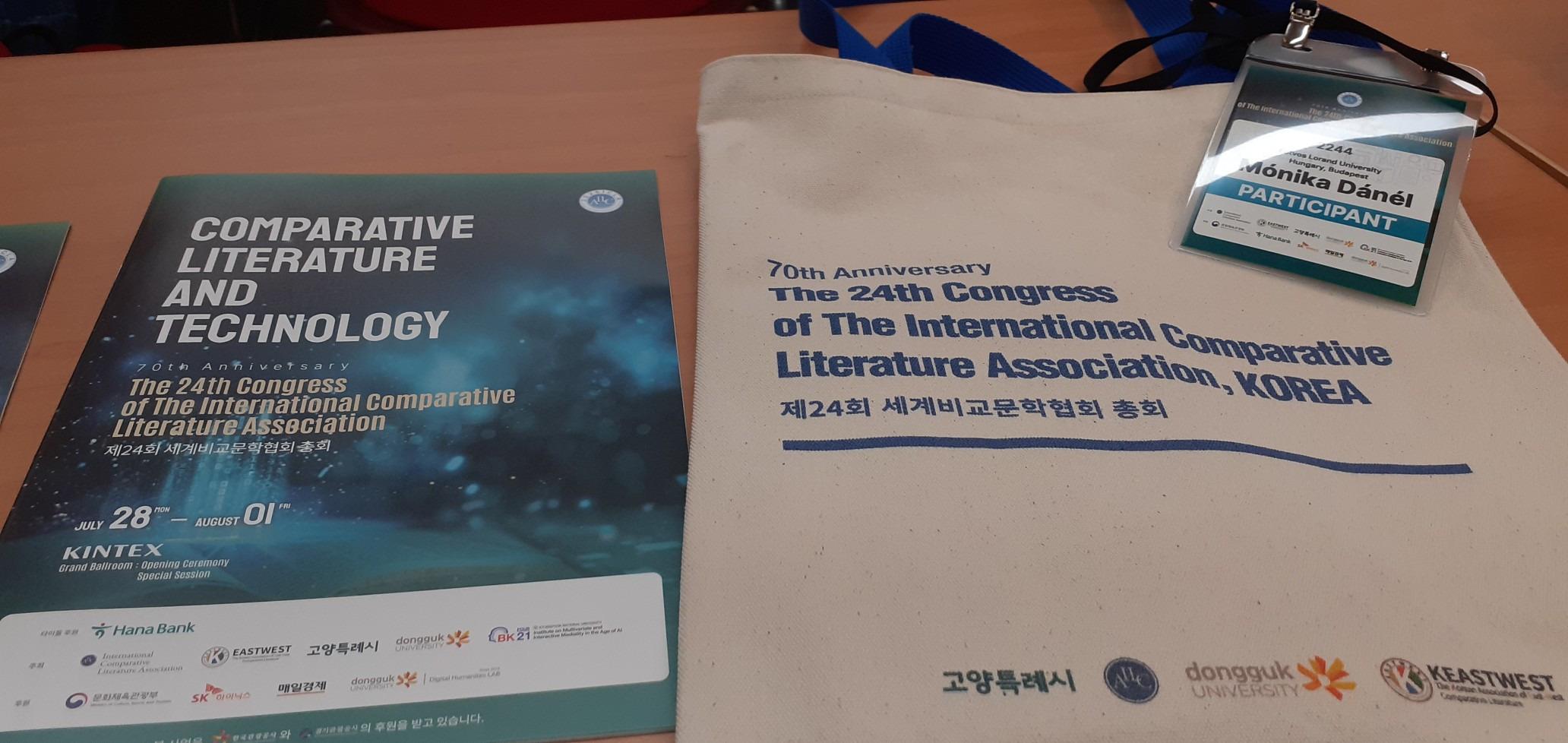


Mónika Dánél will give a lecture at the 2025 ICLA Congress in Seoul. More information:
2025 ICLA Congress - ConfTool Pro - BrowseSessions https://share.google/OO78Q8wy3TNWaf9m4
2025 ICLA Congress - ConfTool Pro - BrowseSessions https://share.google/adv2pduozTgOggjiB
ICLA 2025 https://share.google/lkUEqx2uIcOYiZEBm
"ID: 1502 / 362 H: 4
ICLA Research Committee Individual Submissions
Topics: R13. ICLA Research Committees Proposal - Language Contact in Literature: Europe
Keywords: multilingualism, language contact, nomadism, Hungarian Transborder Literature, Hungarian Émigré Literature
Poetical and Institutional Nomadism – Figures of In-Betweenness in the Hungarian Émigré and Transborder Literature
Mónika Dánél
Eötvös Loránd University, Hungary
In my presentation I will focus on specific literary phenomena, which are saturated by manifest and latent multilingualism. Hungarian transborder literature and émigré literature have come to form two distinct categories in the literary historical discourse, and they are a result of two distinct forms of mobility. Transborder Hungarian literature came to denote works produced in the Hungarian language within the territories of Romania, Slovakia, Ukraine and Serbia (the former Czechoslovakia, USSR, and Yugoslavia respectively), where significant Hungarian minority populations exist as a result of the post-WWI redrawing of the region’s borders. This conceptual categorization could be seen as an example of what Brubaker calls “the movement of borders over people” (2015, 136). Émigré literature, or as it is often referred to locally, the Hungarian literature of the West – as “the movement of people over borders” (Brubaker ibid.) – has been produced by authors who left Hungary in 1946-48 during the consolidation of state-socialist rule and the aftermath of the 1956 revolution.
Firstly, I will concentrate on these two literary phenomena from the institutional categorization perspective: how the inherent linguistic otherness, i.e. the coexistence of these literatures with other, surrounding languages dislocates both the traditional descriptive categories with which Hungarian literary history operates, and the viability of a literary canon based on the borders of the nation state.
Secondly, through analyzing István Domonkos’s Rudderless (1971) poem and Andrea Tompa’s The Hangman’s House (2010I) novel, I elaborate a nomadic poetics that challenges the normative frames of grammar, syntax, genre, and medium by creating diverse multilingual language contacts."